
ECM.1793-2010
Parts
Object number
ECM.1793-2010
Object type
Identification
Title
Cosmetic spoon
Title Type
assigned by cataloguer
Description
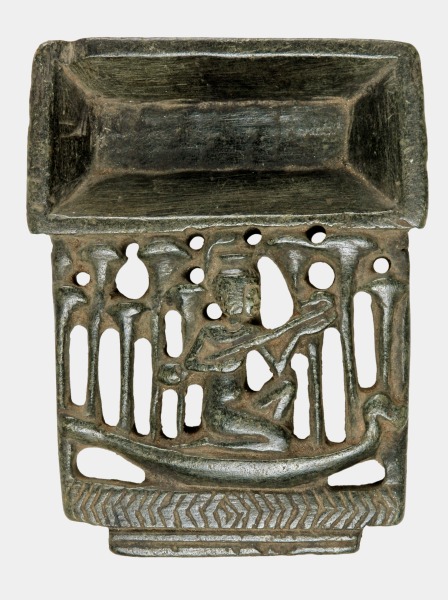
Steatite cosmetic spoon with kneeling female figure on a boat
Features
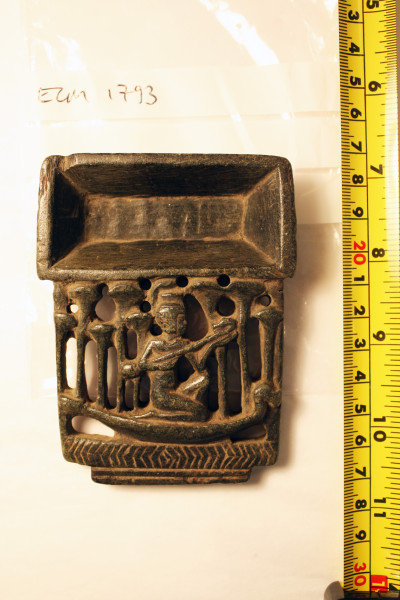
Cosmetic 'spoon' of grey steatite, the bowl in the form of a rectangular pool with sloping sides and flat base, the handle a rectangular openwork panel with a girl kneeling right in a duck prowed skiff playing a lute, papyrus reeds behind.
Comments
Web images used with permissiong of The Barber Institute
Description
Dimensions
Width: 7.6cm
Material
Stone
steatite
steatite
Materials & techniques note
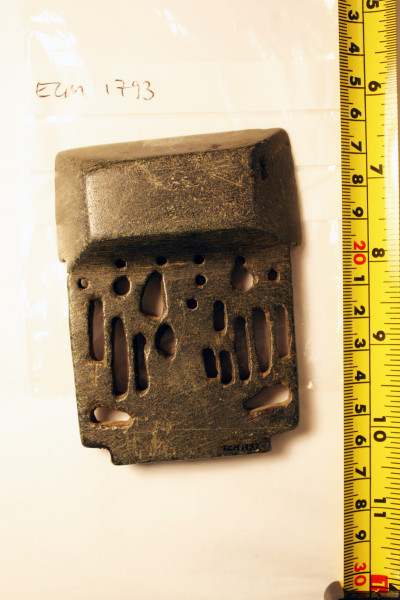
The object is composed of a single piece of carved, drilled, and polished steatite. There are extensive polishing marks and scratches on the inside of the dish as well as on the back of the object, though some of these may be relatively recent. The unresolved drill holes and scratched surfaces may also suggest the object is unfinished. SB
Physical description
This object is a rectangular steatite cosmetic spoon. The spoon’s bowl is a long rectangle. The handle, which is as wide as thebowl, is decorated with an openwork scene of a nude young woman playing a lute. She wears a short wig and kneels on apapyrus skiff. The bow of the skiff takes the form of a bird’s head, which parallels the bird-headed handle of the lute. The sceneis in a papyrus marsh, with several plants around the girl. The boat rests on a long, thin rectangle with an incised, radiatingdiamond pattern meant to represent water. This object dates to the 18th Dynasty based on style, theme, and comparativepieces (Freed 1982, 206-213).
The accession number "ECM 1793" is written in black ink on a shiny barrier layer on the reverse of the piece, near the bottom of the proper right side.
The accession number "ECM 1793" is written in black ink on a shiny barrier layer on the reverse of the piece, near the bottom of the proper right side.
Production
Place
Egypt
Note
Cosmetic dishes were a common item in ancient Egypt. Fine examples, such as this, could be from a number of originalcontexts. They are found in domestic contexts where they were used to spoon cosmetic salves. They are also found in tombcontexts for continued cosmetic use in the afterlife. Finally, they are found in temple contexts as votive offerings (Freed 1982,207). The original context of this object is unknown. The scene of the lute on the handle is commonly found on 18th-Dynastycosmetic pieces. The music and papyrus marsh have connections to Hathor and fertility. The young woman herself may in factbe a representation of a young Hathor (Kozloff and Bryan 1992, 354). The style of the wig worn by the girl is similar to one wornby royal women from the reign of Akhenaton onward. Another cosmetic spoon showing a young woman in a similar wig isdated to the reign of Amenhotep III (Kozloff and Bryan 1992, 358), so this style may have become popular in the private spherebefore gaining popularity with royal women. The bird heads on the papyrus skiff and the lute are typical for a scene of this styleand period (Peck 1982, 208).JW
History and association
Associated cultural affinity
Ancient Egyptian
Associated person
Myers, William Joseph, 1858 - 1899 (Compiler)
Object history note
Exhibited at the Roemer-und Pelizaeus Museum, Hildesheim, Germany, "Meisterwerke agyptischer kunst schatze aus dem Myers Museum an Eton College", April 2004 - January 2005
Field collection
Collection place
Egypt
Field collector
Myers, William Joseph, 1858 - 1899 (Collector)