
FDA-A.1060-2020
Parts
Object number
FDA-A.1060-2020
Object type
Identification
Title
Thompson's ‘Mouseman' Altar
Title Type
assigned by cataloguer
Description
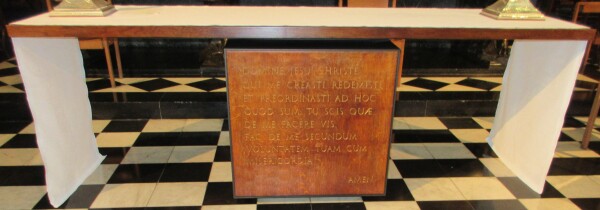
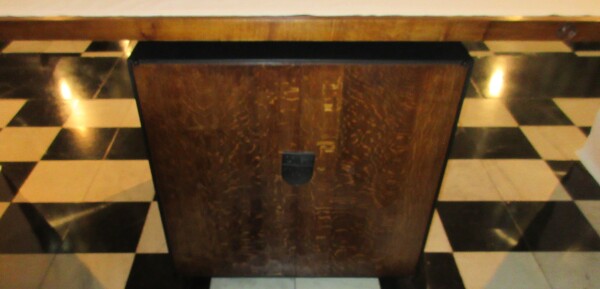
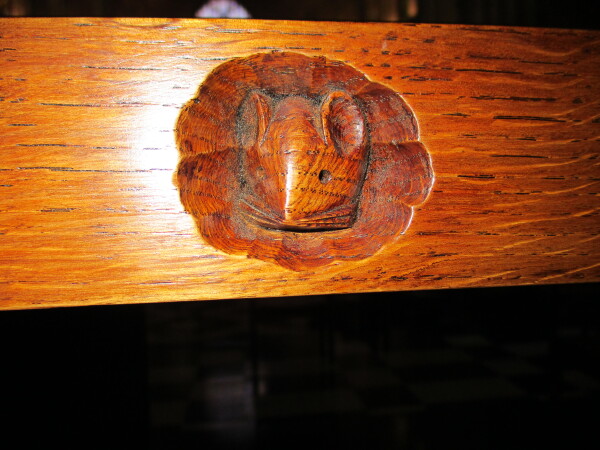
English adzed oak, bronzed patinated steel and parcel-gilt altar table, rectangular top, rear edge with two scalloped roundels with a carved mouse's head, cubic base, oak front with Founder's Prayer, rear with a pair of oak cupboard doors
Comments
This bespoke commission has been made by the renowned furniture makers - Thompson's of Yorkshire.
The mouse's head carved on the edge of the top is a trademark feature of the firm.
Thompson's continue the legacy of Robert ‘Mouseman' Thompson, the original founder of the firm, who was born in 1876.and lived in Kilburn, North Yorkshire, where he set up a business manufacturing oak furniture, which featured a carved mouse on almost every piece. He taught himself to use traditional tools and by 1919 he was experimenting with his own ideas for producing furniture based on the English styles of the 17th century and also based upon his own designs.
Thompson was part of the 1920's revival of craftsmanship, inspired by the Arts and Crafts Movement led by William Morris, John Ruskin and Thomas Carlyle. The workshop, now being run by his descendants and is furniture can be is highly collectable.
The celebrated mouse symbol, found on every piece by Robert Thompson, can be related to a story told by Robert Thompson himself in that one of his craftsmen remarked that they “Were all as poor as church mice”, whereupon Robert carved a mouse on the church screen he was working on. That particular mouse has never been found but it has continued as a trade mark of the Thompson craftsman.
The mouse's head carved on the edge of the top is a trademark feature of the firm.
Thompson's continue the legacy of Robert ‘Mouseman' Thompson, the original founder of the firm, who was born in 1876.and lived in Kilburn, North Yorkshire, where he set up a business manufacturing oak furniture, which featured a carved mouse on almost every piece. He taught himself to use traditional tools and by 1919 he was experimenting with his own ideas for producing furniture based on the English styles of the 17th century and also based upon his own designs.
Thompson was part of the 1920's revival of craftsmanship, inspired by the Arts and Crafts Movement led by William Morris, John Ruskin and Thomas Carlyle. The workshop, now being run by his descendants and is furniture can be is highly collectable.
The celebrated mouse symbol, found on every piece by Robert Thompson, can be related to a story told by Robert Thompson himself in that one of his craftsmen remarked that they “Were all as poor as church mice”, whereupon Robert carved a mouse on the church screen he was working on. That particular mouse has never been found but it has continued as a trade mark of the Thompson craftsman.
Description
Dimensions
height (actual size): 960mm
width (actual size): 2760mm
depth (actual size): 840mm
width (actual size): 2760mm
depth (actual size): 840mm
Inscription
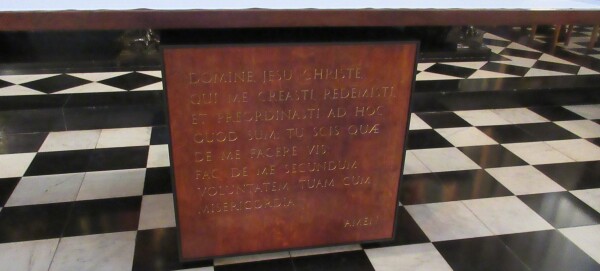
The front oak panel incised with gold lettering: 'DOMINE. JESU CHRISTE. / QUI ME CREASTI. REDEMSTI, / ET PREORDINASTI AD HOC / QUOD SUM; TU SCIS QUÆ / DE MI FACERE VIS; / FAC DE ME SECUNDUM / VOLUNTATEM TIAM CUM / MISERICORDIA. / AMEN.'
Material
oak
steel
gilding
steel
gilding
Physical description
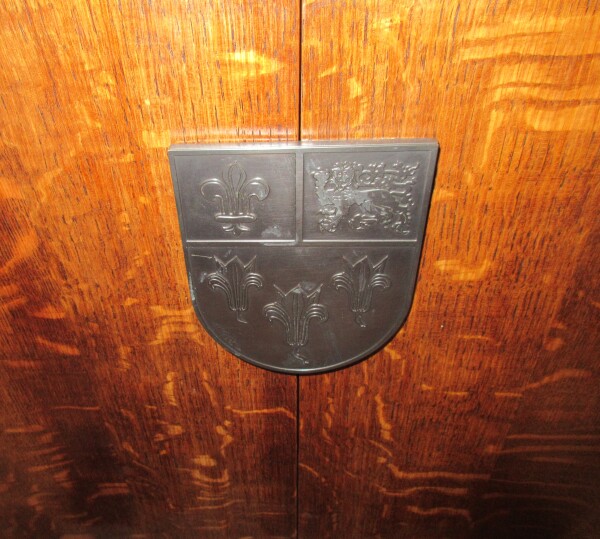
English adzed oak, bronzed patinated steel and parcel-gilt altar table; the rectangular top with the rear edge with two scalloped roundels with a mouse's head, the base in the form of an oak cube with bronzed steel exterior, the front with Founder's Prayer in gold lettering, the rear with a pair of cupboard doors, with rotating bronzed steel escutcheon in the form of the Eton crest sliding to reveal the keyhole
Production
Person
Stirling, Oliver (Designer)
Organisation
Date
2018