
FDA-A.175-2013
Parts
Object number
FDA-A.175-2013
Object type
Identification
Title
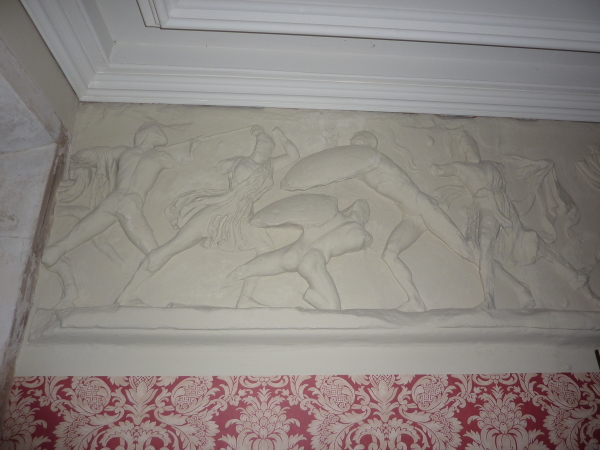
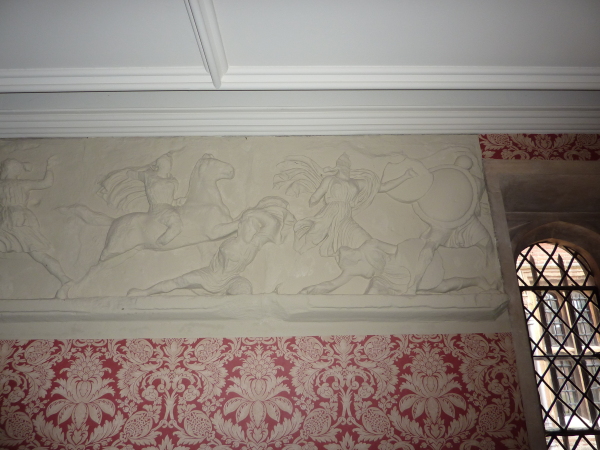
Cast of Frieze from the Mausoleum of Halicarnassus: South Side
Title Type
assigned by cataloguer
Description
Halikarnassos plaster relief panel, south side
Comments
The plaster casts of friezes, inserted high on the walls either side of the Entrance Hall, show a battle between the Greeks and the Amazons. They are cast from surviving parts of the original frieze at the Mausoleum of Halicarnassus (or Halikarnassos) in Turkey. One of the Seven Wonders of the World, it was built to house the remains of Mausolus, ruler of the ancient district of Caria in southwestern Asia Minor. Mausolus’ Mausoleum was constructed at Halicarnassus, which was the capital of Caria, at around the time of his death in 353/352 BCE.
In 1749, Viscount Charlemont chartered a boat to sail through the Ionian Sea as part of his Grand Tour. He discovered fragments of the Halicarnassus reliefs mounted on the inner walls of the Castle of St Peter’s at Bodrum, in south west Turkey, which had been built using materials from the ancient Mausoleum. In 1846, Stratford Canning (1786–1880), British Ambassador to the Ottoman Empire, was granted permission by the Ottoman sultan Abdülmecid I to remove sections of the frieze. The sculptures were sent to the British Museum, where casts were taken from them. In 1853, Stratford Canning presented a set of the casts to Eton College and they were installed in their current position within the Provost’s Lodge.
This is one of two similar casts of freizes from the Mausoleum of Halikarnassos (Turkey; destroyed by multiple earthquakes) showing a battle between Greeks and the Amazons. The original individual sections of the friezes are in the British Museum.
"[The original works] became the first important Greek reliefs to arrive in the British Museum since the Parthenon frieze. There was some uncertainty as to exactly where they should best be exhibited in the existing scheme of stylistic excellence, and they remained packed away. Meanwhile the Prussian Ambassador in London requested that casts might be taken in 1848 for display in Berlin, and a year later, the Museum’s in-house plaster specialist Inglis, began to make moulds. 12 sets were produced, and one was retained for Canning. Recipients included the Royal Collection of Art. Eton was not forgotten. In 1853 the College paid for the ‘carriage of marbles’ and spent three times that sum, £12 10 0, ‘for fixing friezes to the Provost’s Entrance Hall’. They have remained there ever since, following an order slightly different from the originals in the British Museum."
[Research notes by Louisa Connor, c.2000]
This work is made up of seven individual sections of freize.
Description
Dimensions
height (actual size): 900mm
length (actual size): 7390mm
length (actual size): 7390mm
Material
plaster
Materials & techniques note
painted plaster
Production
Date
pre-1852
History and association
Associated object
FDA-A.106-2010 (one of a pair)