
FDA-D.183-2010
Parts
Object number
FDA-D.183-2010
Object type
Identification
Title
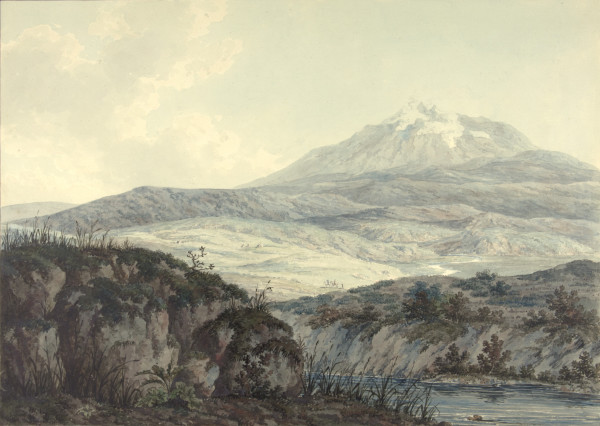
Mount Hekla, Iceland
Whiteley
Whiteley
Title Type
assigned by cataloguer
collection
collection
Comments
This grand and beautifully-coloured view of Mount Hekla was composed by Dayes from a drawing made on the spot by Lieutenant Piercie, a member of John Stanley's expedition to Iceland in 1789. John Thomas Stanley (1766-1850), later the First Lord Stanley of Alderley, had made several continental tours before setting out as one of the first English explorers of Iceland. A man of enquiring mind and considerable learning, he married the equally well-educated Maria Josepha Holroyd (1771-1863), a young woman to whom William Hayley addressed a poem in 1795.
Mout Hekla had erupted in 1766, the year of Stanley's birth, and was of obvious geological and picturesque interest. The 1766 eruption, which lasted on until 1768, is by no means the most recent, and the volcano remains active. So well-known was the 1766 eruption that it was even used as a metaphor for jealous rage in a contemporary poem, 'Precepts of Conjugal Happiness', by John Langhorne (1735-1779):
Of one dark Foe,
one dangerous Foe beware!
Like Hecla's Mountain,
while his Heart's in Flame,
His Aspect's cold,
and Jealousy's his Name,
... True tender Love
one even Tenor keeps;
Tis Reason's Flame,
and burns when Passion sleeps.
After the expedition of 1789 Stanley commissioned at least seventeen finished watercolours of Iceland from Dayes and a further sixteen from Nicholas Pocock. At this period the most ambitious of expeditions, such as Lord Macartney's embassy to China, employed professional draughtsmen. Less wealthy explorers such as Stanley commonly used the skills of amateur crew members and then employed professionals to redraw and colour their views, either for the production of engraved illustrations or, as in this case, for their own private enjoyment. Dayes made other watercolours of this kind. A 'View on the Rhine frm Col. Howgill' is recorded in his 1789 diary, for example. J.M.W.Turner made numbers of similar watercolours, based on the drawings of others, for a variety of publications. Dayes's own 'Instructions for Drawing and colouring Landscapes' draws attention to the skills that differentiated the amateur and the professional and speaks eloquently of his own methods. In the context of 'Mount Hekla' his comments on light and shade and colouring are particularly apposite:
'In disposing the picture into masses of light and shade, care should be taken not to scatter them, or to make them too numerous. The general rule is, not to exeed three masses of light...''
When finishing a watercolour he advises that:
'In washing up a drawing, the hair-pencils should be used as large as the parts worked upon will admit. The shadows and middle tints being worked up to a sufficient degree of power [in Prussian blue and brown Indian ink wash], colouring will be the next operation. this must be done by beginning in the in the distant parts, coming on stronger and stronger, colouring light and middle-tint to the foreground; and, lastly, re-touch the darker parts of the fore-ground with Van-Dyck brown'.
Dayes is of considerable importance in the history of watercolour painting, thanks in large part to his influence on Girtin (who was his apprentice from May 1798) and Turner. Temperamentally he was apparently 'neither amiable nor happy' and he committed suicide in 1804.
Commissioned by Lord Stanley of Alderley who led an expedition to Iceland in 1789.
Dayes was one of the most versatile artists of his day. He supplemented his initial training under the mezzotint engraver William Pether with study at the Royal Academy Schools, which he entered in 1780. Now remembered chiefly as a watercolourist, his output embraced print-making, book illustration, miniature portraits and, towards the end of his life, an unsuccessful foray into painting historical subject pictures in oils. He committed suicide in 1804.
Mount Heckla was painted from sketches made during an expedition to Iceland in 1789 led by John Stanley, later 1st Lord Stanley of Alderley. The group sailed from Leith on 26 May and called at the Orkneys and the Faroe Islands before reaching Iceland. The expedition did not employ a professional draughtsman, but on their return Dayes and Nicholas Pocock were each commissioned to make a series of watercolours based on the travellers' sketches, the sketch for this work being made by Lieutenant Piercie. Seventeen views by Dayes were sold by Stanley's descendants in 1964, and a further sixteen by Pocock in 1965, of which eight are now in the National Museum in Reykjavik. Mount Heckla is the most active volcano on Iceland. The largest recorded eruption in its history had taken place only years before the expedition's arrival, beginning in April 1766 and continuing until May 1768.
Other number
MFW 9
Description
Dimensions
height (actual size): 355mm
width (actual size): 501mm
width (actual size): 501mm
Inscription
Signed 'Edwd. Dayes del.' (lower left) and inscribed as title (on the artist's original mount)
Materials & techniques note
Pencil and watercolour in the artist's original wash line border
Production
Person
Dayes, Edward, 1763 - 1804 (Artist)
Date
1791
History and association
Object history note
Provenance: Collection of John Thomas Stanley, later 1st Lord Stanley of Alderley; by descent; sold through Sotheby's, 9 December 1964 (Lot 72); bt Agnew; with Spink; collection of Martin Whiteley by whom bequeathed to Eton College
Exhibited: 'A Genius for Watercolour', Christie’s, London, 6 to 24 January 2003, catalogue number 50
Exhibited: 'A Genius for Watercolour', Christie’s, London, 6 to 24 January 2003, catalogue number 50
Previous ownership
Whiteley, Martin F, 1930 - 1984: Bequeathed to Eton by Martin Whiteley