
FDA-D.264-2010
Parts
Object number
FDA-D.264-2010
Object type
Identification
Title
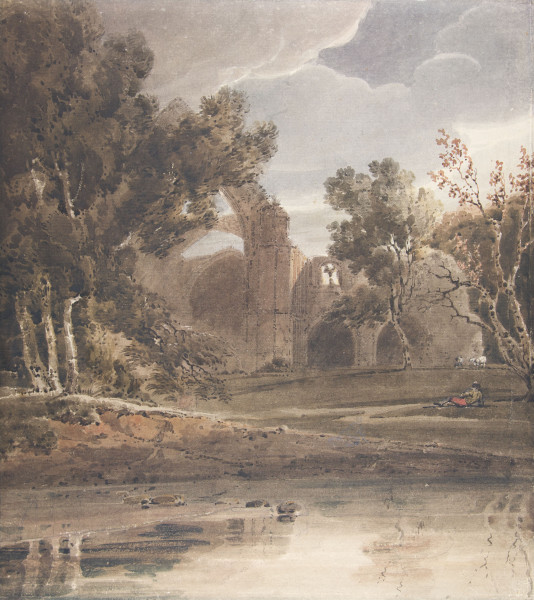
Bolton Abbey, Yorkshire – Evening
Pilkington
Title Type
assigned by cataloguer
collection
Comments
The ruins of Bolton Abbey are here presented as romantic and secluded, belying their increasing popularity with tourists. This work is based on one of three sketchbook drawings Girtin made on the spot (Whitworth Art Gallery). The same sketch inspired other works in a landscape format, but here, one third of the right hand side of the composition is omitted and the water in the foreground is extended to suit a portrait format. A reclining figure, seen to the right, appears in several of the artist’s works of similar date.
Thomas Girtin's career began, somewhat unusually for a landscape painter of his generation, with an apprenticeship. In the summer of 1789 he committed himself to what would have been a traditional seven-year attachment to the landscape painter Edward Dayes. A rare survival from this period is a watercolour dated 1790 (when Girtin was aged fifteen), 'Eton College from the Datchet Road', now in the collection of the Yale Center for British Art. One of Girtin's earliest known works, this is more likely to have been copied from a watercolour or drawing by Dayes than to have been drawn on the spot.
Girtin seems not to have completed his apprenticeship, but in the mid 1790s his artistic horizons were broadened through association with the medical doctor and keen amateur artist and collector, Thomas Monro. The doctor specialised in mental illnesses and cared for John Robert Cozens in the last years of his life. He also acquired a large number of uncoloured drawings and tracings by Cozens: he paid Girtin and the young J.M.W.Turner to make finished copies from these, Girtin drawing the outlines and Turner applying the watercolour wash. A number of other artists such as William Alexander and John Sell Cotman also benefited from Monro's friendship, studying his collection at his London home in the Adelphi, and using his country house at Fetcham in Surrey as a base for sketching expeditions.
Girtin's first visit to Yorkshire is believed to have taken place in 1796. He returned on at least two more occasions. The Eton watercolour of Bolton Abbey was almost certainly based on studies made there in the summer of 1800. By this date the artist was a regular exhibitor at the Royal Academy and in the spring of 1801 he submitted an oil painting, 'Bolton Bridge', to the annual exhibition with a view to seeking election as an Associate that year. The exhibited picture, Girtin's only recorded oil, was much praised but failed to secure the artist any votes and was subsequently lost or destroyed.
The Eton 'Bolton Abbey' is an intense and deeply romantic picture which gives some hint as to the appearance of Girtin's oil paintings of the period. It shows the east end of the Priory ruins as seen from across the River Wharfe and is based on a drawing in the so-called Shepherd Sketchbook, now in the Whitworth Art Gallery. A more prosaic landscape-format watercolour of the same view, showing the scene in morning rather than evening light, is in the collection of Leeds City Art Gallery.
One of three water-colours based on a sketch in the Shepherd Notebook of 1800.
Related works by Girtin are in the collections of the National Museum of Wales, Cardiff and Leeds City Art Gallery.
Other number
Pi 84
Description
Content (note)
'When Girtin made his first trip to Yorkshire, in 1799, Bolton Abbey was already established as one of the high points in any picturesque tour of the country. Girtin drew the ruin on the banks of the River Wharfe from three different angles. In addition, he noted against the stub of a sheet removed from his book of studies that another view. ‘coloured on the spot’ was sold to a Mr Rogers for eight guineas. In the Eton watercolour the abbey is viewed from across the river. These details, together with the reclining shepherd, strengthen a sense no longer present, and the building is half submerged in trees. These details, together with the reclining shepherd, strengthen a sense of isolation, which may not have been entirely in accord with the present-day reality of the place as a tourist destination, but were in harmony with eighteenth-century ideas of the countryside as a place of retirement and contemplation.
There are more extended, horizontal versions of the composition in the National Museum of Wales, Cardiff and Leeds City Art Gallery.'
[Source: Wilcox, T., 'A Genius for Watercolour: Watercolours from the Eton College Collection', Christie's, London, 2003, p.46, catalogue number 38]
Dimensions
height (actual size): 361mm
width (actual size): 323mm
Materials & techniques note
Pencil and watercolour
Production
Person
Girtin, Thomas, 1775 - 1802 (Artist)
History and association
Object history note
Exhibited: 'A Genius for Watercolour', Christie’s, London, 6 to 24 January 2003, catalogue number 38; 'Watercolours from the Eton College Collections', Verey Gallery, Eton College, 24 November 2018 to 24 February 2019
Previous ownership
Pilkington, Alan, 1879 - 1973: Given to Eton by Alan Pilkington, 1969; at Eton from 1963
Poulter, E: With Agnew's 1953
Cohen, Edward
References
• Ryan, H., Hidden Treasures, W.S. Fine Art exhibition catalogue, 2010 (p. 46, no. 18)
• Wilcox, T., A Genius for Watercolour; Watercolours from the Eton College Collection, Christie's exhibition catalogue, London, 2003 (p. 46, no. 38)
• Hill, D., Thomas Girtin, Genius in the North, 1999 (Under no. 16, p. 32, note 16)
• Van Oss, O., 'English Water-colours at Eton: the Pilkington Collection', Apollo, LXXXIII, March 1966 (p. 202, fig 1)
• Pilkington, A., Loan exhibition of early English watercolours, drawings by Old Masters, etchings & engravings from the collection of Alan D. Pilkington: in aid of the Distressed Gentlefolk's Aid Association, Colnaghi & Co, London, 1958 (no. 42)
• Girtin, T. & Loshak, D., The Art of Thomas Girtin, London, 1954 (p. 185, no. 376 (B) iii)
• Loan exhibition of water-colour drawings by Thomas Girtin: in aid of the National Art-Collections Fund, which celebrates its Fiftieth Anniversary in 1953, Thomas Agnew & Sons, London, 1953 (no. 8)
• Burlington Fine Arts Club, Exhibition of the works of Thomas Girtin, London, 1875