
FDA-D.313-2010
Parts
Object number
FDA-D.313-2010
Object type
Identification
Title
Hyde Park – Winter
Pilkington
Pilkington
Title Type
assigned by artist
collection
collection
Description
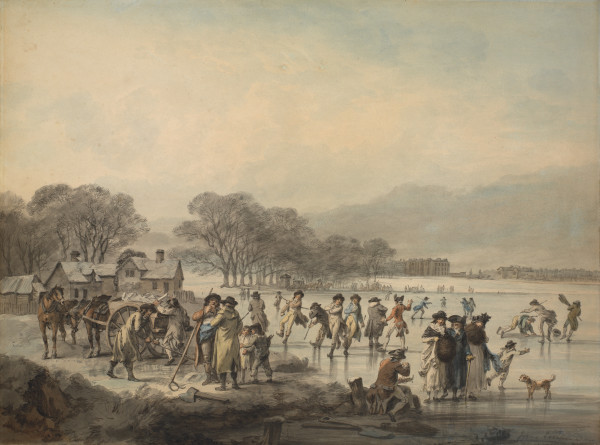
Painted view of figures skating on a frozen river, with houses and rows of trees
Comments
This large watercolour was clearly intended for public exhibition. It hung at the Royal Academy in 1796 under the title 'Hyde Park - winter', paired with 'A View of Hyde Park - summer', a picture now in the collection of the Yale Center for British Art, New Haven. In the Academy catalogue the winter view was marked with an asterisk, indicating that it was 'for disposal' while the summer view was unmarked and therefore either pre-sold or a commissioned picture. The 'Morning Chronicle' of 27 April 1796 singled out Ibbetson's exhibits as 'extremely fine' and Rotha Clay, the artist's twentieth-century biographer, described these two watercolours as works 'of outstanding quality'.
'Winter' shows a busy skating scene on the Serpentine. This artificial lake was created in 1730 on the suggestion of Queen Caroline, a keen landscape gardener. It was made by damming the Westbourne, a river that rose in West Hampstead and flowed into the Thames through the grounds of Chelsea Hospital. Two yachts were put on the lake for the entertainment of the royal family. In the hard winters of the late eighteenth and early nineteenth centuries the Serpentine offered wider entertainment to Londoners from all walks of life, as Ibbetson's watercolour shows. The last great instance of derring-do on the frozen lake took place in 1826 when a tradesman, Mr Hunt of Hunt's Matchless Blacking, drove his four-horse delivery van across the ice for a wager of a hundred guineas.
Ibbetson shows that ice from the fringes of the Serpentine was also put to good practical use.On the left of the drawing a goup of men wth axes and forks are breaking ice and loading it into a two-wheeled cart. This was obvioulsy destined to fill the underground ice-house or ice well of some local grandee where it could last for up to two years. London ice houses and wells survive at Marble Hill House, Ham House and Holland Park.
Ibbetson's life was dogged by personal tragedy: he suffered the deaths of his first wife and of eight children and, for most of his career, struggled to make a living. Against the odds he produced a mass of sunny and often humorous watercolours and oil paintings that illustrate the British way of work and play at the turn of the century.
Exhibited with its Summer companion at the Academy in 1796 and a subject first shown by the artist in 1786.
Born near Leeds, Ibbetson was first apprenticed to a tradesman painter in Hull before running away to London. He exhibited at the Royal Academy from 1785 and continued to show regularly for the next thirty years, a mixture of oils and watercolours, landscapes and figure subjects taken from everyday life.
His second appearance at the Academy, in 1786, was with an oil of a skating scene in Hyde Park which was published as one of a pair the following year with the title 'Winter Amusement'. This was the period of the 'mini Ice Age' in Britain, with a series of particularly hard winters. The Thames froze on a number of occasions, the last being in 1814; after the completion of the new London Bridge in 1831, the wider arches allowed too great a flow of water for the river to freeze.
This 1796 scene of skating in Hyde Park was paired at the Academy with a summer scene entitled 'A view in Hyde Park - Summer', which is now identified as the watercolour 'St James's Park - Summer ' in the Yale Center for British Art. Ibbetson was certainly aware of the success of De Loutherbourg's 'Winter morning with a party skating', exhibited in 1776 and engraved in 1784, but republished in 1794 with a pair entitled 'Summer evening'.
Description
Dimensions
height (actual size): 438mm
width (actual size): 594mm
width (actual size): 594mm
Inscription
Signed 'Julius Ibbetson ad nat' (lower right)
Materials & techniques note
Pen & grey ink, and watercolour
Production
Person
Ibbetson, Julius Caesar, 1759 - 1817 (Artist)
Date
1796
History and association
Object history note
Provenance: Collection of Alan Pilkington; by whom presented to Eton College in 1969
Exhibited: Royal Academy, 1796 as 'Hyde Park - Winter'; Hidden Treasures, 2010; 'A Genius for Watercolour', Christie's, London, 2003; 'Loan exhibition of Early English Watercolours, Drawings by Old Masters, Etchings & Engravings from the Collection of Alan D. Pilkington', Colnaghi & Co, London, 1958; 'Watercolours from the Eton College Collections', Verey Gallery, Eton College, 24 November 2018 to 24 February 2019
Exhibited: Royal Academy, 1796 as 'Hyde Park - Winter'; Hidden Treasures, 2010; 'A Genius for Watercolour', Christie's, London, 2003; 'Loan exhibition of Early English Watercolours, Drawings by Old Masters, Etchings & Engravings from the Collection of Alan D. Pilkington', Colnaghi & Co, London, 1958; 'Watercolours from the Eton College Collections', Verey Gallery, Eton College, 24 November 2018 to 24 February 2019
Previous ownership
References
• Ryan, H., Hidden Treasures, W.S. Fine Art exhibition catalogue, 2010 (p. 32, no. 11)
• Christie's, A Genius for Watercolour; Watercolours from the Eton College Collection, exhibition catalogue, London, 2003 (p. 36, no. 29)
• McConnell, J. (ed.), Treasures of Eton, London, 1976 (p. 113, pl. 20)
• Hardie, M., Water-Colour Painting in Britain, London, 1966, vol.I (p. 154)
• Pilkington, A., Loan exhibition of early English watercolours, drawings by Old Masters, etchings & engravings from the collection of Alan D. Pilkington: in aid of the Distressed Gentlefolk's Aid Association, Colnaghi & Co, London, 1958 (no. 13)
• Royal Academy of Arts, Winter Exhibition, 1951-1952: The first hundred years of the Royal Academy, 1769-1868, London, 1951 (no. 462)
• Clay, R.M., Julius Caesar Ibbetson, London, 1948 (pp. 45-6, 129 & pl. 53)