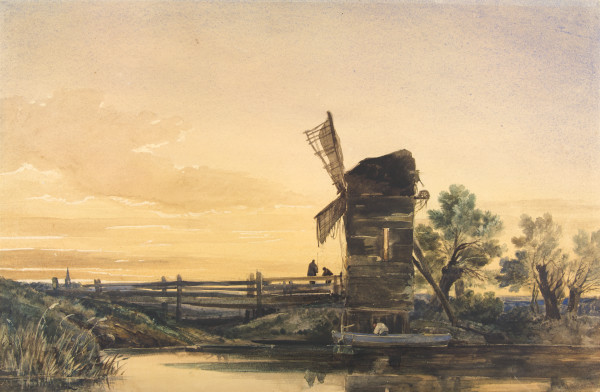

FDA-D.361-2010
Parts
Object number
FDA-D.361-2010
Object type
Identification
Title
Evening, a Windmill in Norfolk
Pilkington
Pilkington
Title Type
assigned by cataloguer
collection
collection
Comments
Windmills transform the force of the wind into power. The vertical windmill, with sails rotating around a horizontal axis, was developed in 12th-century northwestern Europe to mill grain, pump water, or drive other machinery. As with watermills, their economic importance declined with the industrial revolution, and they are now widely loved historic buildings and a Dutch cultural icon. In the 21st century, wind turbines are a form of renewable energy, but many people object to their impact on the natural landscape, very different to this peaceful scene by landscape painter William James Muller (1812-45).
Other number
Pi 129
Description
Dimensions
height (actual size): 332mm
width (actual size): 506mm
width (actual size): 506mm
Inscription
Signed and dated, lower right: 'W Muller '39'
Materials & techniques note
Pencil and watercolour with scratching out
Production
Person
Müller, William James, 1812 - 1845 (Artist)
Date
1839
History and association
Object history note
Provenance: Collection of Alan Pilkington; by whom presented/bequeathed to Eton College
Exhibited: 'Elemental', Verey Gallery, Eton College, 6 November 2025 to 14 June 2026 (catalogue number 48)
Exhibited: 'Elemental', Verey Gallery, Eton College, 6 November 2025 to 14 June 2026 (catalogue number 48)
Previous ownership
Pilkington, Alan, 1879 - 1973: Bequeathed to Eton by Alan Pilkington, 1973; at Eton by 1963
References
• Wilcox, T., The Romantic Windmill: The Windmill in British Art from Gainsborough to David Cox, 1750-1850, Exhibition Catalogue, Hove Museum & Art Gallery, 1993 (p. 81), Catalogue number: 60 illustrated