
FDA-D.374-2010
Parts
Object number
FDA-D.374-2010
Object type
Identification
Title
The Hall, Evans's
Title Type
assigned by cataloguer
Comments
Joseph Nash was born in Great Marlow and at the age of 21 was apprenticed to the architectural draughtsman Augustus Pugin. He became a skiful exponent of the romantic style of the 1830s, painting literary subjects in mediaeval settings. He was elected to the Watercolour Society in 1834 and became a full member in 1842. He was then working on the four sets of lithographs, The Mansions of England in Olden Time, he produced between 1839 and 1849. Nash also made lithographs of many of the gothicised interiors of Windsor Castle, and while working in the town would surely have taken part in the artists' conversaziones William Evans was fond of hosting with fellow members of the Watercolour Society.
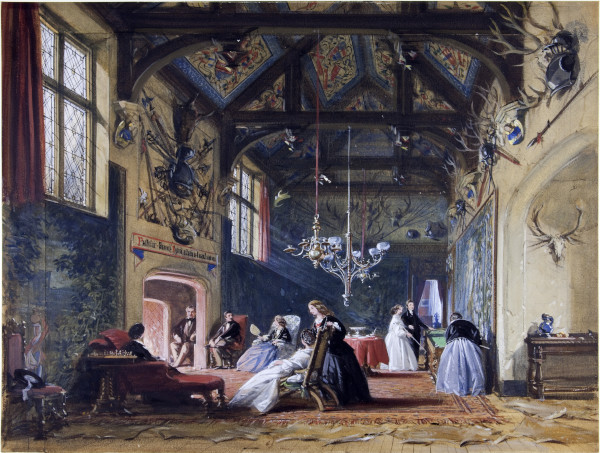
The 'baronial hall' at the boarding house that William Evans took charge of in 1839 was created by roofing over a space between two buildings. It was furnished in appropriate style with antlers, armour and tapestries, a decor which continued to be added to through to the 1870s. According to an old inscription on the mount, Evans himself is depicted seated in the fireplace, with two of his children, Sam (born in 1829) and Annie (born in 1824) beside him. In the foreground are Helen Coleridge (the wife of housemaster Edward Coleridge, the poets's nephew) and Miss Griffith, daughter of Evan's' dealer, with an unidentified woman. Playing billiards beyond them are George and Harriet Drury and, with her back to the viewer, Jane Evans, another of the artist's daughters. Evans' diary records the arrival of tapestries for the hall in 1874, after Annie's death in 1871, yet it seems unlikely that Nash would have painted her as simply another member of this convivial gathering of Evans' family and friends. If she is indeed present in the picture, she might be the figure on the extreme left, dressed in black, with her face turned from view.
Painted by the author of 'Mansions of England in the Olden Time', this shows the 'Hall' at Evans's which the artist designed , complete with the arms including, as William's bequest to Jane Evans makes clear, swords 'with which the Dukes of Buckingham and Shrewsbury fought at Burnham Beeches, given to me by Mr Angelo, and which had been in his family ever since-the Spear of Tippoo Saib as found in his grasp at Seringapatam, and given by George the Fourth to Mr Girding who gave it to me'. The mottoes and chandeliers, executed to William's design, were among the last additions. William's sporting trophies are very evident. Just one panel of the original roof painting now survives. The hall had become much fuller than when, in 1850, Dickens left his son Charlie in 'a big hall with an immense fireplace by himself'.
An old key lists the portraits as being of William Evans in the inglenook, Sam Evans and Annie Evans (who died in 1871) talking, Helen Coleridge and Miss Griffith together, George and Harriet Drury, and Jane Evans playing billiards. The woman seated on the chaise-longue is not identified.
The 'baronial hall' at the boarding house that William Evans took charge of in 1839 was created by roofing over a space between two buildings. It was furnished in appropriate style with antlers, armour and tapestries, a decor which continued to be added to through to the 1870s. According to an old inscription on the mount, Evans himself is depicted seated in the fireplace, with two of his children, Sam (born in 1829) and Annie (born in 1824) beside him. In the foreground are Helen Coleridge (the wife of housemaster Edward Coleridge, the poets's nephew) and Miss Griffith, daughter of Evan's' dealer, with an unidentified woman. Playing billiards beyond them are George and Harriet Drury and, with her back to the viewer, Jane Evans, another of the artist's daughters. Evans' diary records the arrival of tapestries for the hall in 1874, after Annie's death in 1871, yet it seems unlikely that Nash would have painted her as simply another member of this convivial gathering of Evans' family and friends. If she is indeed present in the picture, she might be the figure on the extreme left, dressed in black, with her face turned from view.
Painted by the author of 'Mansions of England in the Olden Time', this shows the 'Hall' at Evans's which the artist designed , complete with the arms including, as William's bequest to Jane Evans makes clear, swords 'with which the Dukes of Buckingham and Shrewsbury fought at Burnham Beeches, given to me by Mr Angelo, and which had been in his family ever since-the Spear of Tippoo Saib as found in his grasp at Seringapatam, and given by George the Fourth to Mr Girding who gave it to me'. The mottoes and chandeliers, executed to William's design, were among the last additions. William's sporting trophies are very evident. Just one panel of the original roof painting now survives. The hall had become much fuller than when, in 1850, Dickens left his son Charlie in 'a big hall with an immense fireplace by himself'.
An old key lists the portraits as being of William Evans in the inglenook, Sam Evans and Annie Evans (who died in 1871) talking, Helen Coleridge and Miss Griffith together, George and Harriet Drury, and Jane Evans playing billiards. The woman seated on the chaise-longue is not identified.
Other number
CL 14
Description
Content (note)
The figures depicted include William, Sam and Annie Evans, Helen Coleridge, Miss Griffith, George and Harriet Drury, and Jane Evans
Dimensions
height (actual size): 400mm
width (actual size): 520mm
width (actual size): 520mm
Materials & techniques note
Pencil and watercolour with gum arabic, heightened with bodycolour (sheet extended along the lower, upper left edges)
Production
Person
Nash, Joseph, 1808 - 1878 (Artist)
Date
c.1874
History and association
Object history note
Provenance: Collection of William Evans of Eton; by whom bequeathed to his daughter, Mary Wanklyn; by whom presented to Eton College
Exhibited: 'William Evans of Eton 1798-1877: A Bicentenary Exhibition', The Brewhouse Gallery, Eton College, ? to 1 August 1998, catalogue number 5
Exhibited: 'William Evans of Eton 1798-1877: A Bicentenary Exhibition', The Brewhouse Gallery, Eton College, ? to 1 August 1998, catalogue number 5
References
• Wilcox, T., A Genius for Watercolour; Watercolours from the Eton College Collection, Christie's exhibition catalogue, London, 2003 (p. 21), Catalogue number: 14
• Connor, L.M., William Evans of Eton 1798-1877, exhibition catalogue, Brewhouse, Eton 1998 (p. 47), Catalogue number: 5
• Connor, L.M., William Evans of Eton 1798-1877, exhibition catalogue, Brewhouse, Eton 1998 (p. 47), Catalogue number: 5