
FDA-P.41-2010
Parts
Object number
FDA-P.41-2010
Object type
Identification
Title
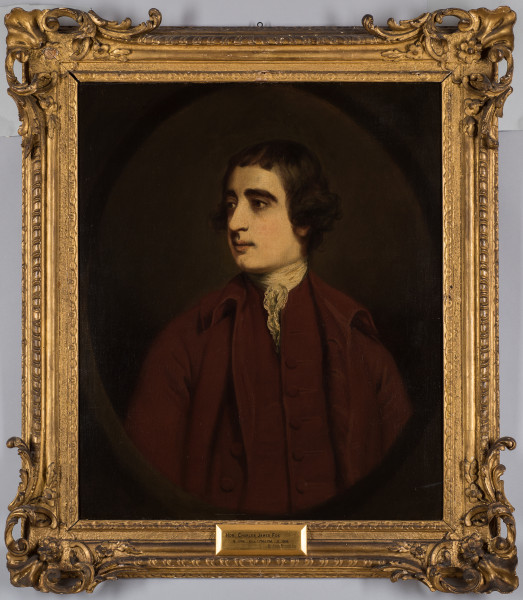
Charles James Fox
Title Type
assigned by cataloguer
Description
Half-length portrait of a young man, in a red coat and waistcoat, and a white stock, feigned oval
Comments
Fox was the youngest son of Henry Fox, 1st Lord Holland. Like his father and brother he was educated at Eton. In 1763 his father took him away from school for a trip to Paris, a visit which caused much excitement amongst his school-fellows and laid the foundation for his later wild life. One of Fox's favourite vices was gambling. Within a month of his coming up to Oxford he wrote to his father expressing his resolve 'never to play again', though with the qualification: 'I think I shall have courage enough to keep it, but cannot be sure enough of myself to give an absolute promise'. This uncertainty as to his own self-control was justified: on one occasion his father had to pay his debts to the tune of £140,000. Indeed, on his second trip to Paris in 1765, he pursued gambling and more sensual pleaseures so assiduously that the Secretary at the British Embassy, David Hume, wrote to Fox's father: ' The dissipation of this kind of Parisian life might check his ardour after useful knowledge, and lose in all appearance a very great acquisition to the public'. Fox became a major politician and orator as well as a man of great personal charm, culture and sensibility, and one of the best known figures of his time. His influence on a number of Etonian politicians, like Lord Grey and Samuel Whitbread, was considerable.
Eton Leaving Portraits are portraits of an (Old) Etonians, painted to mark their time at the College. There are some 280 in the College Collections. The earliest is attributed to Thomas Hudson (1701-1779) and was painted in 1754. The most recent are by photographic artist Tereza Cervenova and were made in 2024.
The tradition evolved from the earlier custom of boys presenting Leaving Money to the Head Master as they left the College. Edward Barnard was the first Head Master to request a Leaving Portrait in addition to the money. Barnard continued to honour one or two boys with the privilege of presenting their portrait each year. Later, Head Master Joseph Goodall suggested that boys present drawn portraits (1850s examples are in the ground floor Coat Lobby), explaining ‘it is by no means my wish to make this an expensive compliment’. Works were given directly to Head Masters, who later presented their collections to the College. Some Head Masters became Provosts and so displays of portraits moved into the Lodge.
Most Leaving Portraits were painted within three years of the sitter leaving the College. However, Charles James Fox... is shown at 13, while Frederick Irby, whose portrait is in a boarding house, was painted from an earlier portrait in the year he turned 36. Leaving Portraits are generally on 30 x 20 inch canvases, a standard portrait size. However, there are many exceptions, such as Sir Thomas Lawrence’s impressive and larger portrait of Edmund Antrobus... Two distinct portraits of the sitter were often commissioned, so that both the College and the sitter’s family each received a portrait, neither being considered a copy.
By the end of the 1850s, the recurrent Leaving Portrait tradition had died out. But it has since been reignited several times by Head Masters and Provosts, the first being M. R. James, who commissioned several Leaving Portraits on behalf of the College.
At Eton 1758-64
Eton Leaving Portraits are portraits of an (Old) Etonians, painted to mark their time at the College. There are some 280 in the College Collections. The earliest is attributed to Thomas Hudson (1701-1779) and was painted in 1754. The most recent are by photographic artist Tereza Cervenova and were made in 2024.
The tradition evolved from the earlier custom of boys presenting Leaving Money to the Head Master as they left the College. Edward Barnard was the first Head Master to request a Leaving Portrait in addition to the money. Barnard continued to honour one or two boys with the privilege of presenting their portrait each year. Later, Head Master Joseph Goodall suggested that boys present drawn portraits (1850s examples are in the ground floor Coat Lobby), explaining ‘it is by no means my wish to make this an expensive compliment’. Works were given directly to Head Masters, who later presented their collections to the College. Some Head Masters became Provosts and so displays of portraits moved into the Lodge.
Most Leaving Portraits were painted within three years of the sitter leaving the College. However, Charles James Fox... is shown at 13, while Frederick Irby, whose portrait is in a boarding house, was painted from an earlier portrait in the year he turned 36. Leaving Portraits are generally on 30 x 20 inch canvases, a standard portrait size. However, there are many exceptions, such as Sir Thomas Lawrence’s impressive and larger portrait of Edmund Antrobus... Two distinct portraits of the sitter were often commissioned, so that both the College and the sitter’s family each received a portrait, neither being considered a copy.
By the end of the 1850s, the recurrent Leaving Portrait tradition had died out. But it has since been reignited several times by Head Masters and Provosts, the first being M. R. James, who commissioned several Leaving Portraits on behalf of the College.
At Eton 1758-64
Description
Content (person)
Fox, Charles James, 1749 - 1806 (Sitter)
Dimensions
height (sight size): 744mm
width (sight size): 620mm
height (frame): 980mm
width (frame): 856mm
depth (frame): 61mm
weight: 6kg
width (sight size): 620mm
height (frame): 980mm
width (frame): 856mm
depth (frame): 61mm
weight: 6kg
Inscription
I.D. label on frame
Materials & techniques note
Oil on canvas
Physical description
Carved gilt wood frame, elaborate carved corners
Production
Person
Reynolds, Joshua (Sir), 1723 - 1792 (Artist)
Date
1762
History and association
Object history note
Provenance: Commissioned by the sitter or his family; by whom presented to the Head Master at Eton College in 1762
Exhibited: 'Exhibition of the Royal House of Guelph' (Hanover Exhibition), New Gallery, London, 1890-1891, catalogue number 122; 'Eton Leaving Portraits', Tate Gallery, London, April to May 1951, catalogue number 2; 'Leaving Portraits from Eton College', Dulwich Picture Gallery, 18 July to 20 October 1991, catalogue number 5
Exhibited: 'Exhibition of the Royal House of Guelph' (Hanover Exhibition), New Gallery, London, 1890-1891, catalogue number 122; 'Eton Leaving Portraits', Tate Gallery, London, April to May 1951, catalogue number 2; 'Leaving Portraits from Eton College', Dulwich Picture Gallery, 18 July to 20 October 1991, catalogue number 5
References
• Cust, L., Eton College Portraits, 1910 (p.15, no.9, Plate I)
• Graves, A. & Cronin, W. V., A History of the Works of Sir Joshua Reynolds, 1909 (p.331)
• Waterhouse, E.K., Reynolds, 1941 (p.54)
• Mannings, David, 'Sir Joshua Reynolds: A Complete Catalogue of His Paintings', published 2000 (Text volume, p.202, catalogue number 673)
• Graves, A. & Cronin, W. V., A History of the Works of Sir Joshua Reynolds, 1909 (p.331)
• Waterhouse, E.K., Reynolds, 1941 (p.54)
• Mannings, David, 'Sir Joshua Reynolds: A Complete Catalogue of His Paintings', published 2000 (Text volume, p.202, catalogue number 673)