
FDA-Sc.67-2017
Parts
Object number
FDA-Sc.67-2017
Object type
Identification
Title
Funerary Monument to Thomas Murray
Description
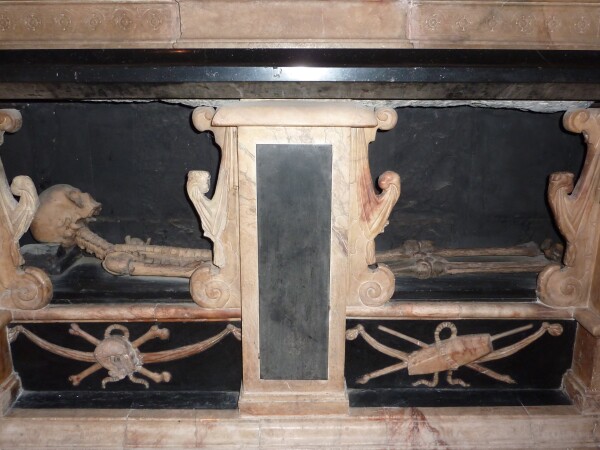
Memorial monument, which includes a recumbent skeleton, bust and canopy.
Comments
'Murray died from the effects of a painful operation within fourteen months after his election to the Provostship, and was buried in the Church, where his relict set up in his memory a monument, elaborately painted an gilded, opposite to the simple epitaph of his illustrious predecessor, Savile.'
[Source: H.G. Lyte, A History of Eton College 1440-1898, p.216]
'Inside the main Chapel the handsome Jacobean monument to Provost Murray, dated 1623+, is by Maximilian Colt, a Huguenot from Arras whose real name was Poultrain, of which Colt is a punning translation. Colt’s royal barges have vanished but the College of Heralds still treasures his book of coloured designs for monuments. His also are the tomb of Queen Elizabeth in Westminster Abbey and that of the first Earl of Salisbury at Hatfield, possibly his masterpiece. The great Lord Treasurer lies there on a thick slab of touchstone, supported by Fortitude, Temperance, Truth and Justice—the nonecclesiastical virtues—holding in his hand, as he himself had directed, the white staff of his high office. It is the only one that has survived, as etiquette demanded that the Lord Treasurer broke his staff on leaving office. Beneath him, in the same posture, lies his skeleton, just as does Murray’s beneath his portrait here. It was a common convention in that death-obsessed age. Mrs. Esdaile observes that though Hamlet has been more commented on than almost any other English work, no single commentator on that play about death has mentioned the skulls and skeletons that grinned down at every parish congregation in England— “Dost thou think Alexander lookt o’ this fashion i th’ earth?”'
[Source: 'Eton Busts' by Oliver Van Oss, Etoniana, No.123, November 29, 1969, p.359]
[Source: H.G. Lyte, A History of Eton College 1440-1898, p.216]
'Inside the main Chapel the handsome Jacobean monument to Provost Murray, dated 1623+, is by Maximilian Colt, a Huguenot from Arras whose real name was Poultrain, of which Colt is a punning translation. Colt’s royal barges have vanished but the College of Heralds still treasures his book of coloured designs for monuments. His also are the tomb of Queen Elizabeth in Westminster Abbey and that of the first Earl of Salisbury at Hatfield, possibly his masterpiece. The great Lord Treasurer lies there on a thick slab of touchstone, supported by Fortitude, Temperance, Truth and Justice—the nonecclesiastical virtues—holding in his hand, as he himself had directed, the white staff of his high office. It is the only one that has survived, as etiquette demanded that the Lord Treasurer broke his staff on leaving office. Beneath him, in the same posture, lies his skeleton, just as does Murray’s beneath his portrait here. It was a common convention in that death-obsessed age. Mrs. Esdaile observes that though Hamlet has been more commented on than almost any other English work, no single commentator on that play about death has mentioned the skulls and skeletons that grinned down at every parish congregation in England— “Dost thou think Alexander lookt o’ this fashion i th’ earth?”'
[Source: 'Eton Busts' by Oliver Van Oss, Etoniana, No.123, November 29, 1969, p.359]
Other number
FDA-A.290-2013
Description
Content (person)
Murray, Thomas, 1564 - 1623 (Sitter)
Dimensions
length (actual size): 1520mm
width (actual size): 290mm
width (actual size): 290mm
Materials & techniques note
Carved and painted gilded marble monument, with carved wood skeleton
Physical description
Elaborate black and brown marble monument with wooden skeleton and carved half-body effigy
Production
Person
Date
c.1623