
FDA-D.1553-2016
Parts
Object number
FDA-D.1553-2016
Object type
Identification
Title
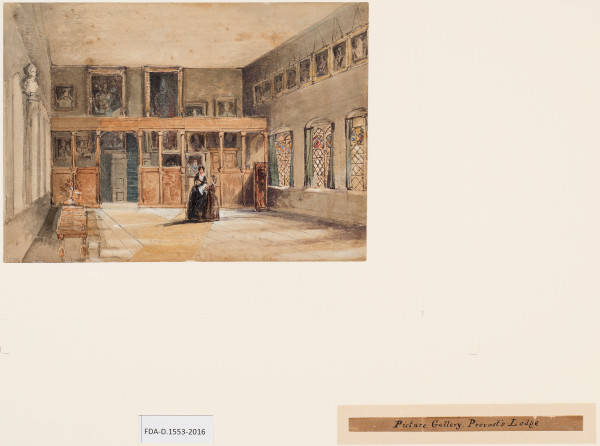
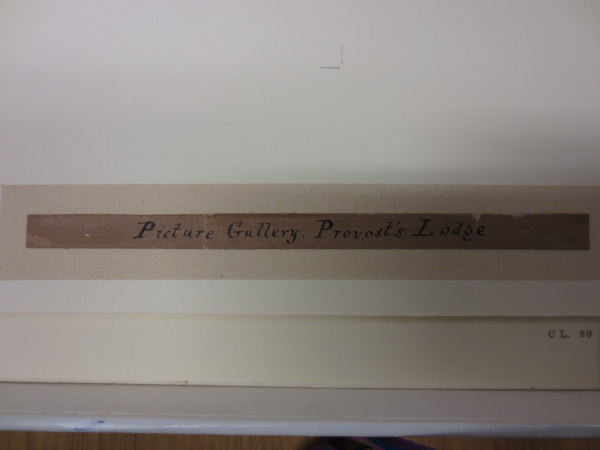
Picture Gallery, Provost's Lodge (Interior of Election Hall)
Title Type
assigned by cataloguer
Description
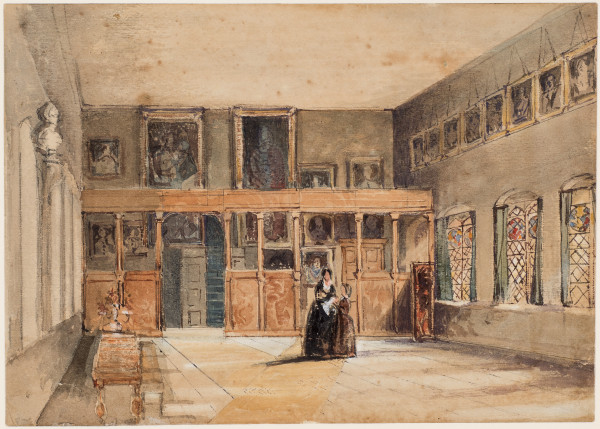
Interior of Election Hall with Thomas Smith screen, stained glass, paintings and figures.
Comments
Built in 1517–21 as a library, stained glass roundels in this room are thought to represent literary subjects, giving some indication of how the books, chained to desks, were arranged.
The wooden Tudor screen at the south end of the room was erected in c.1547 by Sir Thomas Smith. Smith was the first married Provost at Eton and it is said that his wife selected this hall as a formal dining room for large gatherings. A screen across the hall was added to conceal the service area. The design of the screen, with ordered Tuscan columns on fluted plinths, was reportedly inspired by Thomas Smith's visits to Italy.
It is now named after the process of election. Maxwell Lyte explained:
Year after year for some four centuries, the Provost of King's [College, Cambridge] rode to Eton about the end of July, in order to take part in the election of scholars suitable for his college at Cambridge and of others to fill their places in the school.
Election Hall became the location where Collegers waited to be examined for a place at King's College, Cambridge. There is also an ongoing tradition that on the first school day of each Michaelmas half, the Provost swears in new Collegers here in a brief Latin ceremony, using the supposed injunction of the Founder to the original scholars, ‘sit bonus puer’ (be a good boy), etc. Today, Election Hall is also used for dinners, talks and music recitals.
This watercolour indicates that Election Hall was previously, at least in part, a space for displaying works of art. It seems not ideal for this purpose, as the numerous windows and large fireplace mean that works have to be hung high. The art on display in this watercolour is not easy to identify and may in fact be the private collection of a mid- or late 19th-century Provost.
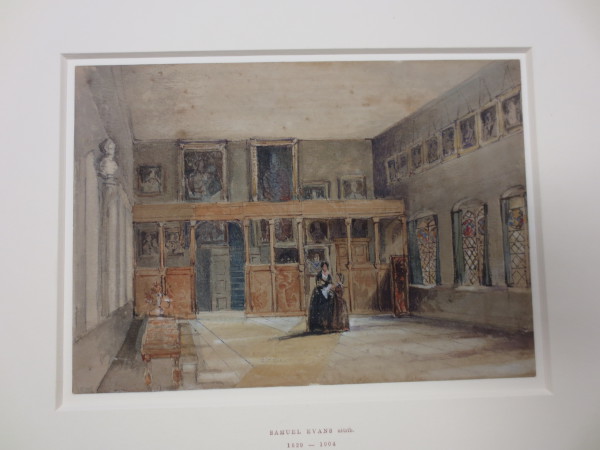
This work is by Samuel Evans, the son of William Evans (1798–1877), who was the best-known of four generations of Eton drawing masters. The Evans family taught successively at the College from 1808 until 1922. When William resigned as Eton Drawing Master in 1853, he was succeeded by Samuel. Soon after the appointment, Samuel moved from Evans's (the boarding house that his father had bought) back into Ballard's opposite, their former family home. There he lived with his sister Jane. From about 1858, the siblings began to take in a small number of boy-lodgers (generally six). During this time, Ballard's was known ‘Sam’s’.
The wooden Tudor screen at the south end of the room was erected in c.1547 by Sir Thomas Smith. Smith was the first married Provost at Eton and it is said that his wife selected this hall as a formal dining room for large gatherings. A screen across the hall was added to conceal the service area. The design of the screen, with ordered Tuscan columns on fluted plinths, was reportedly inspired by Thomas Smith's visits to Italy.
It is now named after the process of election. Maxwell Lyte explained:
Year after year for some four centuries, the Provost of King's [College, Cambridge] rode to Eton about the end of July, in order to take part in the election of scholars suitable for his college at Cambridge and of others to fill their places in the school.
Election Hall became the location where Collegers waited to be examined for a place at King's College, Cambridge. There is also an ongoing tradition that on the first school day of each Michaelmas half, the Provost swears in new Collegers here in a brief Latin ceremony, using the supposed injunction of the Founder to the original scholars, ‘sit bonus puer’ (be a good boy), etc. Today, Election Hall is also used for dinners, talks and music recitals.
This watercolour indicates that Election Hall was previously, at least in part, a space for displaying works of art. It seems not ideal for this purpose, as the numerous windows and large fireplace mean that works have to be hung high. The art on display in this watercolour is not easy to identify and may in fact be the private collection of a mid- or late 19th-century Provost.
This work is by Samuel Evans, the son of William Evans (1798–1877), who was the best-known of four generations of Eton drawing masters. The Evans family taught successively at the College from 1808 until 1922. When William resigned as Eton Drawing Master in 1853, he was succeeded by Samuel. Soon after the appointment, Samuel moved from Evans's (the boarding house that his father had bought) back into Ballard's opposite, their former family home. There he lived with his sister Jane. From about 1858, the siblings began to take in a small number of boy-lodgers (generally six). During this time, Ballard's was known ‘Sam’s’.
Other number
CL 1a
Description
Dimensions
height (actual size): 172mm
width (actual size): 241mm
width (actual size): 241mm
Materials & techniques note
Pencil and watercolour
Production
Person
Evans, Samuel Thomas George, 1829 - 1904 (Attributed to)
Date
19th century