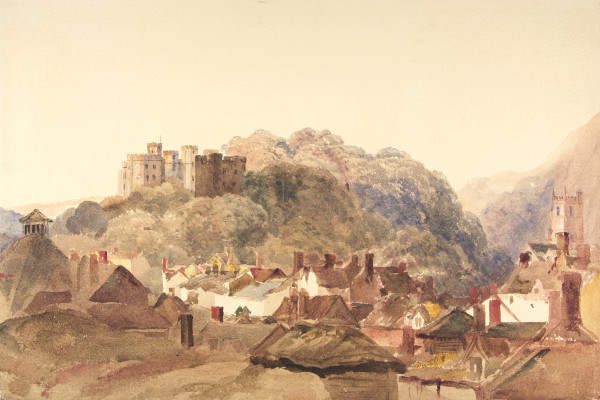

FDA-D.547-2010
Parts
Object number
FDA-D.547-2010
Object type
Identification
Title
Dunster Castle
The Castle, Dunster
Pilkington
Title Type
Common name
Previous title
collection
Comments
Turner and Girtin were both born in 1775, David Cox and Peter De Wint nearly a decade later, in 1783 and 1784 respectively. Turner and Girtin were brought up in the Sandby 'stained drawing' tradition, although they acquired a more painterly approach to watercolour through copying the work of John Robert Cozens. The two younger artists developed an even broader-brush approach to the medium, often using rough or 'gritty' papers to add texture and substance to their watercolours. Both concentrated on landscape, De Wint working exclusively in Britain, and Cox in Britain and France. De Wint's work is less well-documented than that of Cox and underwent fewer stylistic changes during the course of his life: as a consequence it is often difficult to date.
Frustration at the poor conditions under which watercolours were hung at the Royal Academy gave rise to the formation of separate exhibiting societies in London and in the provinces. Cox and De Wint were regular contributors to the Old Watercolour Society's exhibitions where their work exerted a strong influence over the next generation. De Wint showed a watercolour of Dunster at the OWCS (Old Watercolour Society) in 1844 (no.104). This may be the framed and glazed 'Dunster' sold at the artist's posthumous studio sale (lot 492) for £30.9.0. A further unframed 'Dunster' was sold for ten guineas in the same sale (lot 320) and another fore £3.7.0 (lot 270). The artist also made drawings of Minehead, which is a short distance from Dunster, in 1841 and 1842. The Eton view of Dunster is precisely dated to 3 September by the artist. His widow Harriet added 'Dunster' and '1841' to the inscription on the back of the drawing. Harriet De Wint, in a memoir of her husbands's life, says that the artist was 'much pleased ' with north Somerset and north Devon, which he explored as far as Lynton, and 'Minehead and Dunster he considered very beautiful, and the cottages, etc, highly picturesque'. When he became ill in 1848 the memory of his earlier visit to this aread prompted him to return to Devon.
Other number
Pi 212
Description
Dimensions
height (actual size): 366mm
width (actual size): 544mm
Inscription
Inscribed on the verso 'Dunster. / 3rd Septr. 1841'
'3rd Septr.' inscribed by artist; 'Dunster' and '1841' inscribed by the artists's wife, Harriet
Materials & techniques note
Pencil and watercolour
Production
Person
De Wint, Peter, 1784 - 1849 (Artist)
History and association
Object history note
Provenance: Collection of Alan Pilkington; by whom presented/bequeathed to Eton College
Previous ownership
Pilkington, Alan, 1879 - 1973: Bequeathed to Eton by Alan Pilkington, 1973; at Eton from 1961
References
• Ryan, H., Hidden Treasures, W.S. Fine Art exhibition catalogue, 2010 (p. 56, no. 23)
• McConnell, J. (ed.), Treasures of Eton, London, 1976 (p. 115)